
Empire State Building Climbers: Famous Ascents, History, and How They Did It
The Empire State Building has inspired generations of artists, filmmakers, tourists, athletes, and daredevils. But Empire State Building climbers are a much smaller and more unusual group. Reaching the top of the landmark can mean running up its internal staircase, completing an authorized exterior ascent, or illegally scaling restricted parts of the tower.
The distinction matters. The Empire State Building rises 1,454 feet from ground level to the top of its antenna, while the roof of the 102nd floor is about 1,250 feet above the ground. The building contains 102 floors and has become one of New York City’s defining landmarks since opening in 1931.
Several famous ascents have attracted worldwide attention, including Jared Leto’s authorized climb in 2023 and the dramatic 2026 ascent by urban climbers Angelina Nikolau and Ivan Kuznetsov. Their stories reveal just how different legitimate tower climbing can be from unauthorized skyscraper stunts.
Why the Empire State Building Is So Difficult to Climb
The Empire State Building is not simply a tall wall.
Its Art Deco architecture contains setbacks, ledges, vertical sections, structural elements, mechanical areas, and a narrow upper tower that ultimately leads toward the antenna. At its highest point, the building reaches 1,454 feet above Midtown Manhattan.
For comparison, the official Empire State Building Observation Deck Run-Up takes competitors to the 86th floor, about 1,050 feet above ground, using 1,576 stairs. The building’s official site describes the race as covering approximately one-fifth of a mile vertically.
An exterior ascent is fundamentally different.
Instead of walking or running inside a protected stairwell, a climber outside the building must contend with height, exposure, wind, changing surfaces, architectural obstacles, and almost no margin for error.
That is why documented exterior ascents are so unusual.
A Brief History of the Empire State Building
The Empire State Building was constructed between March 17, 1930, and May 1, 1931. The 102-story structure was completed in only one year and 45 days, an extraordinary construction pace for a building of its scale.
When it opened in 1931, it quickly became a symbol of New York and an international representation of skyscraper ambition.
The building’s height also helped establish it as a natural setting for popular culture. Its most famous fictional climber is undoubtedly King Kong, whose 1933 movie appearance turned the skyscraper into one of cinema’s most recognizable landmarks.
Real-life climbers later transformed that fictional image into something much more dangerous.
Famous Empire State Building Climbers
Jared Leto’s Legal 2023 Climb
One of the most unusual modern ascents happened on November 9, 2023, when actor and musician Jared Leto climbed the exterior of the Empire State Building.
Unlike unauthorized rooftop stunts, Leto’s climb was authorized.
He began around the 86th-floor observation deck and climbed the exterior toward the upper section of the building, eventually reaching the area around the antenna’s base. The ascent took roughly 20 minutes. Contemporary reporting described him as the first person to legally climb to the top of the building’s exterior.
Leto wasn’t simply climbing for the publicity spectacle. He used the feat to promote the upcoming world tour of his band, Thirty Seconds to Mars.
He later said the experience was harder than he expected, particularly because of the endurance required and the sharp architectural surfaces.
The climb was carefully arranged rather than an unauthorized attempt to bypass building security. That makes it fundamentally different from the more recent rooftop incidents associated with extreme urban climbers.
Angelina Nikolau and Ivan Kuznetsov’s 2026 Climb
The most dramatic recent example came on July 1, 2026.
Urban climbers Angelina Nikolau and Ivan Kuznetsov, also known publicly as Angela Nikolau and Ivan Beerkus, reached the top of the Empire State Building’s antenna in an unauthorized ascent.
The pair were already known for high-risk skyscraper climbing and had appeared in the 2024 Netflix documentary Skywalkers: A Love Story.
At the top, they displayed a banner and appeared to turn the stunt into a marriage proposal. Police later arrested them, and prosecutors brought multiple charges, including burglary and reckless endangerment.
Authorities also reported that the antenna had to be powered down before officers could safely approach the climbers.
Importantly, reports about precisely how the pair gained access to the restricted upper areas have differed in detail. Authorities alleged that they entered restricted areas and broke through a secured access point, while other reports described an investigation into how they bypassed security.
That uncertainty is worth preserving rather than turning unconfirmed details into established fact.
The incident illustrates a major difference between famous climbing stunts: some are organized with permission, while others involve unauthorized access and criminal consequences.
Alain Robert and the Broader History of Skyscraper Climbing
French climber Alain Robert, widely known as “the French Spider-Man,” is one of the most famous names in modern skyscraper climbing.
Robert has climbed numerous major buildings around the world, including the Empire State Building. National Geographic described him as having scaled dozens of high-rises using his urban climbing techniques.
His career helped popularize the idea of “buildering,” the practice of climbing buildings rather than natural rock faces.
Robert’s climbs also demonstrate why the Empire State Building belongs to a much larger history of urban climbing. The attraction isn’t simply the height of one landmark. For some climbers, skyscrapers provide an entirely different technical environment from mountains or cliffs.
At the same time, Robert’s climbs often involved legal consequences when authorization was absent. His career illustrates the complicated relationship between urban climbing, publicity, law enforcement, and public safety.
How Did the Climbers Reach the Top?
There isn’t one single technique used by all Empire State Building climbers.
An authorized climb can be carefully planned with professional safety systems, controlled access, and support from building personnel. Jared Leto’s 2023 ascent was an example of this type of controlled event.
Unauthorized rooftop climbers operate in a completely different environment.
Experienced urban climbers may use their knowledge of:
- Building geometry
- Structural surfaces
- Hand and footholds
- Ledges and architectural projections
- Balance and body positioning
- Route planning
- Physical endurance
However, explaining these techniques is not the same as providing a safe method for illegally accessing or climbing a skyscraper. The Empire State Building is an occupied landmark with restricted areas, electrical and communications equipment, security systems, and large numbers of visitors.
There is no safe DIY procedure for copying an unauthorized ascent.
The most important thing to understand is that experienced climbers aren’t eliminating the danger. They are operating within an activity where a small mistake can have catastrophic consequences.
Empire State Building Climbers vs. the Run-Up Race
One of the most common misunderstandings surrounding this subject is confusing the Empire State Building Run-Up with exterior climbing.
They are completely different activities.
The Empire State Building Observation Deck Run-Up is an organized athletic competition. Participants race through the building’s internal stairways to the 86th-floor observation deck.
The official 2026 event is scheduled for October 6, with runners covering 1,576 stairs. The men’s course record is 9:33, set by Paul Crake in 2003, while Andrea Mayr holds the women’s record of 11:23 from 2006.
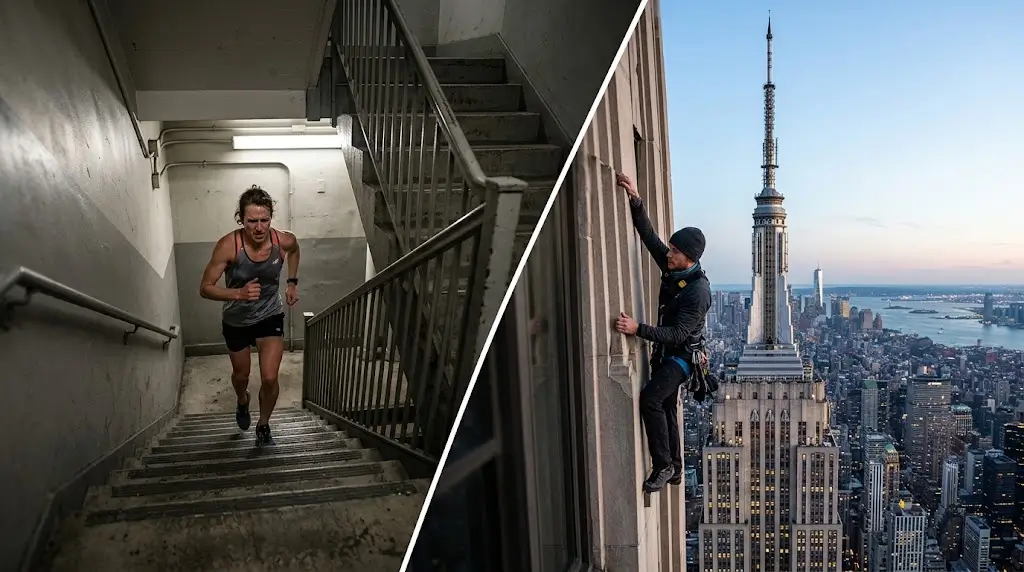
The event dates back to 1978 and has become one of the world’s best-known tower races. The 2026 edition is its 48th annual race.
Some of the competition’s most successful athletes include Thomas Dold, who has seven men’s invitational victories, and Suzy Walsham, who has ten women’s invitational victories.
So when someone says they “climbed the Empire State Building,” it’s important to ask how.
Running 86 floors inside the building is a legitimate sporting challenge. Scaling the exterior is an entirely different undertaking.
How Dangerous Is an Exterior Climb?
Exterior skyscraper climbing is extraordinarily hazardous.
The obvious danger is the height, but height is only one part of the problem.
A climber can also face:
- Strong and unpredictable winds
- Wet or slippery surfaces
- Fatigue
- Loss of grip
- Sudden weather changes
- Narrow structural sections
- Electrical and communications equipment
- Difficulty accessing emergency assistance
- Falling objects
- Security intervention
At the Empire State Building, the antenna itself creates additional complications because it is part of the building’s communications infrastructure.
The 2026 climbers’ case demonstrated this issue. Authorities had to wait for the antenna to be powered down before emergency personnel could safely approach the area.
That detail also explains why a seemingly successful climb can create risks for people other than the climbers themselves.
Can You Legally Climb the Empire State Building?
Ordinary visitors cannot simply decide to climb the outside of the Empire State Building.
The legitimate way for most people to experience the building vertically is through its visitor areas and observation decks. The official site lists observation decks on the 86th and 102nd floors.
For people who want an athletic challenge, the Empire State Building Run-Up provides a legal opportunity to climb hundreds of floors of stairs as part of an organized event.
An exterior climb is a different matter and requires authorization and professional planning. Unauthorized attempts can result in arrests and criminal charges, as the 2026 case demonstrated.
For most visitors, the best way to experience the building is therefore from its official observation areas rather than attempting to reproduce the feats of professional or extreme urban climbers.
Why Are Empire State Building Climbers So Fascinating?
The fascination goes beyond simple danger.
The Empire State Building has represented ambition since its construction. It was built during a period when New York was competing to create increasingly tall and technologically ambitious structures. Its appearance in King Kong then turned the building into a global symbol of impossible scale.
Real climbers add another layer to that history.
Jared Leto’s authorized ascent transformed a promotional event into a highly publicized architectural spectacle. Alain Robert’s career connected the building with the broader world of buildering. And the 2026 Nikolau-Kuznetsov climb demonstrated how social media has changed the way extreme urban climbing is documented and consumed.
The building remains the same landmark, but the reasons people climb it have changed.
For one person, it may represent a childhood dream. For another, a sporting challenge. For another, an artistic or media project. And for extreme rooftop climbers, it can become a test of physical and psychological limits.
Frequently Asked Questions
Who are the most famous Empire State Building climbers?
Among the best-known names associated with Empire State Building climbs are Jared Leto, Alain Robert, and the 2026 rooftop-climbing pair Angelina Nikolau and Ivan Kuznetsov. Their ascents were very different: Leto’s 2023 climb was authorized, while Nikolau and Kuznetsov’s 2026 ascent was unauthorized and resulted in arrests.
Did Jared Leto really climb the Empire State Building?
Yes. Jared Leto made an authorized exterior ascent in November 2023. He climbed from around the 86th floor toward the upper portion of the building and the base of its antenna. The climb took approximately 20 minutes and was connected to the promotion of Thirty Seconds to Mars’ 2024 world tour.
Who climbed the Empire State Building in 2026?
Angelina Nikolau and Ivan Kuznetsov climbed to the top of the Empire State Building antenna on July 1, 2026. The pair were experienced rooftop climbers and were later arrested and charged with several offenses. The climb was unauthorized.
How many stairs does the Empire State Building have?
The building’s official facts page says there are 1,860 steps from street level to the 102nd-floor observation deck. The annual Run-Up uses 1,576 stairs to reach the 86th-floor observation deck.
Is the Empire State Building Run-Up the same as climbing the outside?
No. The Run-Up is an organized stair-running competition inside the building. Exterior climbing involves ascending the outside of the structure and is a completely different activity. The Run-Up reaches the 86th-floor observation deck via 1,576 stairs.
Can tourists climb the outside of the Empire State Building?
Not as an ordinary visitor activity. Tourists can visit the official observation decks, while exterior climbing requires authorization and specialized planning. Unauthorized climbing can lead to serious safety risks and legal consequences.
How tall is the Empire State Building?
The Empire State Building reaches 1,454 feet, or about 443 meters, from ground level to the top of its antenna. The roof of the 102nd floor is approximately 1,250 feet above ground.
Why do people climb skyscrapers?
Motivations vary. Some climbers are interested in the physical challenge, some pursue photography or artistic projects, and others seek publicity or personal achievement. But unauthorized skyscraper climbing can endanger both climbers and responders and may result in criminal charges.
Conclusion
The story of Empire State Building climbers is really a collection of very different stories. The building has hosted an organized stair-running tradition for decades, while authorized exterior ascents such as Jared Leto’s 2023 climb have turned the landmark into a controlled spectacle. Extreme rooftop climbers such as Angelina Nikolau and Ivan Kuznetsov have taken a much more dangerous and unauthorized approach, with serious legal consequences.
The Empire State Building remains 1,454 feet tall and as recognizable as ever, but reaching its summit can mean very different things depending on the route. For ordinary visitors, the official observation decks and Run-Up offer legitimate ways to experience the building’s height without attempting the potentially fatal risks of an unauthorized exterior ascent.