Oliver Tree Autopsy: What We Know About His Cause of Death and Crash Investigation
The Oliver Tree autopsy search has generated considerable interest since the singer and internet personality died in a helicopter collision in Rio de Janeiro, Brazil, on June 14, 2026. But there is an important distinction between what Brazilian authorities confirmed about his remains and what has actually been released about his medical cause of death.
Oliver Tree, whose real name was Oliver Tree Nickell, was 32 when two helicopters collided over the Recreio dos Bandeirantes area of Rio de Janeiro. All six people aboard the two aircraft died. Brazilian authorities later confirmed Tree’s identity through forensic examination of his dental records.
However, the identification of a body is not the same thing as publication of a detailed autopsy report. The reliable sources reviewed for this article confirm the identification process and the aviation investigation, but do not provide a publicly released medical report establishing a specific injury such as burns or blunt-force trauma as Tree’s official cause of death.
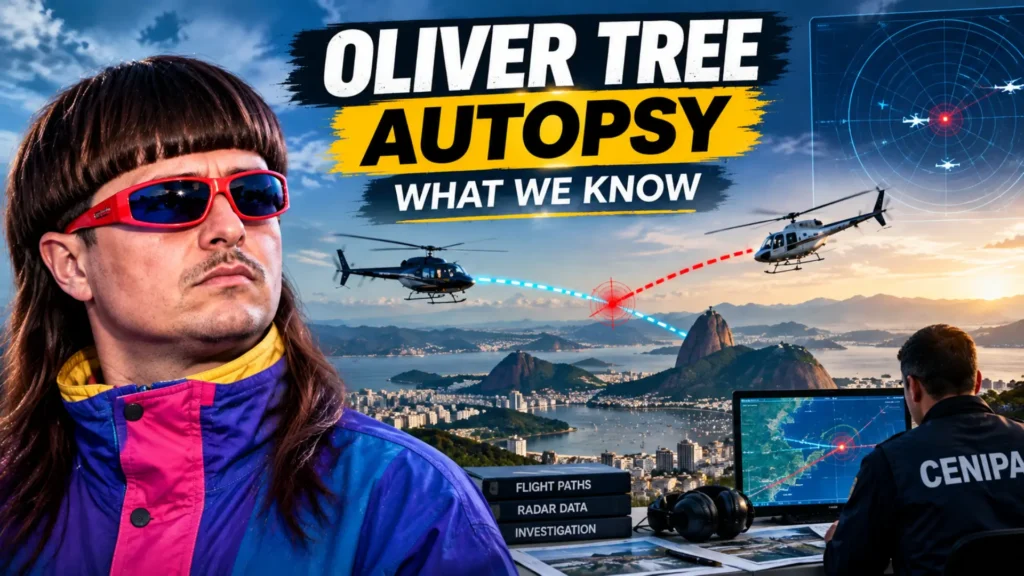
The most concrete explanation currently available concerns the helicopter collision itself. A preliminary CENIPA report found that the aircraft were operating along coinciding routes and that the helicopter carrying Tree was not detected by radar during its flight.
Oliver Tree Autopsy: What Has Actually Been Confirmed?
The most important fact is that Brazilian authorities identified Oliver Tree’s remains after the crash.
On June 16, Brazil’s Instituto Médico-Legal (IML) Afrânio Peixoto completed the identification of the last unidentified victim. Tree was identified through examination of his dental arch.
This matters because early reports said that authorities could not immediately identify all six victims. The condition of the remains made normal identification difficult, so forensic specialists used dental information to establish Tree’s identity.
That does not automatically mean that an autopsy report publicly established the exact physiological cause of his death.
The available reporting instead establishes the broader fatal event: Tree was aboard the Bell 206 helicopter that collided with another helicopter in midair, and there were no survivors.
What We Know vs. What Has Not Been Publicly Established
| Question | What the available evidence shows |
|---|---|
| Did Oliver Tree die? | Yes. Brazilian authorities confirmed his death. |
| When did he die? | June 14, 2026. |
| Where did the crash occur? | Rio de Janeiro, Brazil. |
| Was his body identified? | Yes. The IML identified him through dental examination. |
| Was he aboard the helicopter? | Yes. He was listed as a passenger on PP-MAC. |
| Was there an official detailed autopsy report publicly released? | No such report was identified in the reliable sources reviewed. |
| What caused the aircraft accident? | Still under investigation; CENIPA’s preliminary findings provide important factual details but not a final causal conclusion. |
The distinction is important because online articles sometimes use the phrase “cause of death” when they are actually describing the crash that killed someone.
How Did Oliver Tree Die?
Oliver Tree died in a midair helicopter collision in Rio de Janeiro.
On June 14, two helicopters collided over the Recreio dos Bandeirantes neighborhood in western Rio. The aircraft subsequently crashed into the ground, and one of the helicopters came down in the parking area of a vehicle facility. A fire followed the impact.
Tree was traveling in the Bell 206B registered PP-MAC. Four passengers were aboard with pilot Alexandre Souza, making five occupants in that aircraft. The second helicopter, registered PR-DJJ, had its pilot Charles Marsillac aboard. All six people died.
The accident happened while Tree was in Brazil as part of his international tour.
The June 14 Helicopter Collision
The initial investigation focused on how two helicopters came to occupy the same area of airspace.
Early reports said authorities were considering possible human error and whether pilot actions or air-traffic-control factors contributed to the collision.
Later, CENIPA’s preliminary report supplied more specific factual information about the flight paths.
According to reporting on that preliminary report, the two helicopters were using coinciding Special Helicopter Routes (REHs) and had coinciding flight levels. The collision occurred between the Tachas and Piabas positions along the Grota route.
That finding is significant, but it should not be described as a final determination that a particular person or organization caused the crash.
Where the Crash Happened
The collision occurred in the Recreio dos Bandeirantes area of Rio de Janeiro.
Both aircraft ultimately impacted the ground, with one coming down in the parking area of a vehicle facility. The resulting fire affected numerous vehicles.
The severity of the crash also explains why forensic identification became an important part of the investigation.
What Did the Autopsy and Identification Process Reveal?
The strongest publicly documented forensic finding concerning Oliver Tree is how his identity was established.
Brazil’s IML identified Tree using his dental arch. CNN Brasil reported that the forensic institute completed the identification on June 16 after analyzing his dental characteristics.
Other Brazilian reporting described the remains as severely affected by the crash and subsequent fire, which helps explain why ordinary visual identification was not sufficient.
How Oliver Tree Was Identified
Dental identification is a standard forensic approach when remains are difficult to identify visually.
In Tree’s case, authorities had already identified five other victims. He was the final victim whose identity remained to be formally established.
Once the IML completed the dental comparison, Brazilian authorities confirmed that the last unidentified victim was Oliver Tree.
Why Identification Is Different From Cause of Death
This is where many online searches become confusing.
Identification answers: “Whose remains are these?”
Cause-of-death analysis answers: “What injury, disease, or physical event caused this person’s death?”
Those are related but separate forensic questions.
The available reporting clearly establishes the first answer for Oliver Tree. It does not provide enough verified information to claim that an official publicly released autopsy specifically concluded that he died from a particular type of trauma or burn injury.
Therefore, it would be misleading to present an unverified description of specific injuries as an official Oliver Tree autopsy result.
What Caused the Oliver Tree Helicopter Crash?
As of the latest reliable information reviewed, the final cause of the collision has not been established.
However, the preliminary investigation has revealed several important facts.
The Two Helicopters Were Flying Along Coinciding Routes
CENIPA’s preliminary report found that the flight plans for the two helicopters involved routes that coincided in the relevant area and included coinciding flight levels.
This provides investigators with a critical piece of the accident reconstruction.
It does not, by itself, prove why the aircraft collided.
A final investigation needs to determine how the aircraft were being operated, what each pilot could see, what communications occurred, how the routes were being coordinated and what other operational factors may have contributed.
Tree’s Helicopter Was Not Detected by Radar
One of the most significant preliminary findings concerns PP-MAC, the helicopter carrying Oliver Tree.
CENIPA’s preliminary information reported that PP-MAC was not detected by radar during its flight.
Brazilian reporting described this as an aircraft operating without radar detection. A transponder is important because it allows air-traffic-control systems to receive identifying and altitude information from an aircraft.
The absence of radar detection is potentially important to reconstructing how the two aircraft approached one another.
But again, it should not be automatically translated into a final conclusion that this alone caused the accident.
Neither Helicopter Had Flight Recorders
Another limitation is the lack of traditional flight-data and cockpit-voice recorders.
Reporting based on the preliminary CENIPA findings says that neither helicopter had an FDR or CVR, commonly described as a “black box.”
That means investigators must rely on other evidence to reconstruct the final moments.
Such evidence can include available radar information, GPS data, flight plans, aircraft wreckage, witness accounts and other operational records.
What Does the CENIPA Investigation Say?
The preliminary CENIPA report is important because it adds technical facts to what was initially a rapidly developing news story.
The preliminary information indicates that:
- The accident occurred on June 14, 2026.
- The aircraft were PP-MAC and PR-DJJ.
- They collided in flight over Recreio dos Bandeirantes.
- The planned routes and flight levels coincided in the relevant area.
- PP-MAC was not detected by radar during its flight.
- PR-DJJ could be tracked using available data.
- Neither helicopter carried an FDR or CVR.
- Weather conditions were suitable for visual flight.
Most importantly, the preliminary report does not constitute a final determination of responsibility or cause. Reporting on the CENIPA release explicitly notes that the investigation remained ongoing and that the preliminary document contained information gathered up to that point rather than a final causal conclusion.
Has an Official Cause of Death Been Released?
The safest answer is: the verified sources reviewed do not provide a publicly released detailed autopsy finding that establishes a specific medical mechanism of Oliver Tree’s death.
What is established is that he died as a result of the fatal helicopter collision.
His remains were formally identified by the Rio de Janeiro IML through dental examination, and Brazilian authorities confirmed him as the sixth and final identified victim.
Claims online that state a very specific injury as the “official Oliver Tree autopsy result” should therefore be treated cautiously unless they cite an actual forensic report or statement from the relevant Brazilian authority.
There is also a separate issue concerning the cause of the aviation accident. That investigation is different from determining the medical cause of an individual’s death.
The aviation investigation asks why the helicopters collided.
The forensic examination asks questions about the victims.
Confusing those two processes can create misleading headlines.
Why Online Claims About Oliver Tree’s Autopsy Should Be Treated Carefully
The story surrounding Tree’s death has produced a significant amount of online speculation.
Some early reports were published before authorities could formally identify every victim. Later reporting established that the IML had identified Tree through dental examination.
There have also been false or misleading pieces of crash footage circulated online. AFP, for example, documented a video from a 2024 Malaysian helicopter incident that was falsely presented as footage of the 2026 Brazil crash.
That makes source quality particularly important when researching an Oliver Tree autopsy or cause-of-death claim.
A reliable article should distinguish among:
- Confirmed facts
- Preliminary investigative findings
- Unconfirmed theories
- Social-media speculation
Only the first two categories should be presented as established evidence.
Frequently Asked Questions
What was Oliver Tree’s cause of death?
Oliver Tree died in a fatal helicopter collision in Rio de Janeiro on June 14, 2026. The available reliable sources establish the crash as the event that caused his death, but they do not provide a publicly released detailed autopsy report establishing a specific physical injury as his official medical cause of death.
Was Oliver Tree’s body identified?
Yes. Brazil’s Instituto Médico-Legal identified Oliver Tree as the final unidentified victim of the crash. The identification was completed through examination of his dental arch.
Was Oliver Tree’s autopsy released?
No detailed public autopsy report establishing a specific medical mechanism of death was identified in the reliable sources reviewed. Reports primarily discuss the forensic identification of his remains and the separate investigation into the helicopter collision.
What happened to Oliver Tree’s helicopter?
Tree was aboard helicopter PP-MAC, a Bell 206B. The aircraft collided in midair with another helicopter, PR-DJJ, over Rio de Janeiro’s Recreio dos Bandeirantes area. Both aircraft crashed, killing all six occupants.
What did the preliminary crash investigation find?
CENIPA’s preliminary findings indicated that the two helicopters were operating along coinciding routes and flight levels. It also reported that PP-MAC, the helicopter carrying Tree, was not detected by radar during its flight. Neither helicopter had an FDR or CVR.
Has the final cause of the helicopter crash been determined?
The preliminary findings do not amount to a final cause determination. Investigators were still examining the circumstances surrounding the collision, including flight paths and other operational factors.
Was Oliver Tree’s death confirmed?
Yes. Brazilian authorities confirmed his identity after the IML completed the forensic identification process. His death occurred in the June 14 helicopter collision in Rio de Janeiro.
Conclusion
The Oliver Tree autopsy story requires a careful distinction between forensic identification and an officially published cause-of-death report. Brazilian authorities confirmed that Tree died in the June 14, 2026 helicopter collision in Rio de Janeiro and later identified his remains through dental examination.
The more detailed unanswered questions concern the crash itself. CENIPA’s preliminary findings indicate that the two helicopters were using coinciding routes and flight levels, while the aircraft carrying Tree was not detected by radar. Neither aircraft had conventional flight-data or cockpit-voice recorders.
For now, those findings provide important clues, but they should not be mistaken for a final explanation of the accident or an unpublished autopsy result.