
Lindsey Graham Cause of Death: What Happened to the U.S. Senator?
The Lindsey Graham cause of death was a sudden medical emergency involving an aortic dissection due to arteriosclerotic cardiovascular disease, according to preliminary findings released by the District of Columbia medical examiner after his death. Graham died in Washington, D.C., on July 11, 2026, at age 71, after his office initially described his condition as a “brief and sudden illness.”
The finding answered the main question surrounding the South Carolina senator’s unexpected death, but officials initially emphasized that the medical examination was not yet completely finalized. Toxicological and microscopic testing still had to be completed before the death certificate could be updated from pending status.
Here is what is known about what happened, what an aortic dissection means, and the legacy Graham left after more than three decades in Congress.
What Was Lindsey Graham’s Cause of Death?
The preliminary cause of death was reported as aortic dissection due to arteriosclerotic cardiovascular disease.
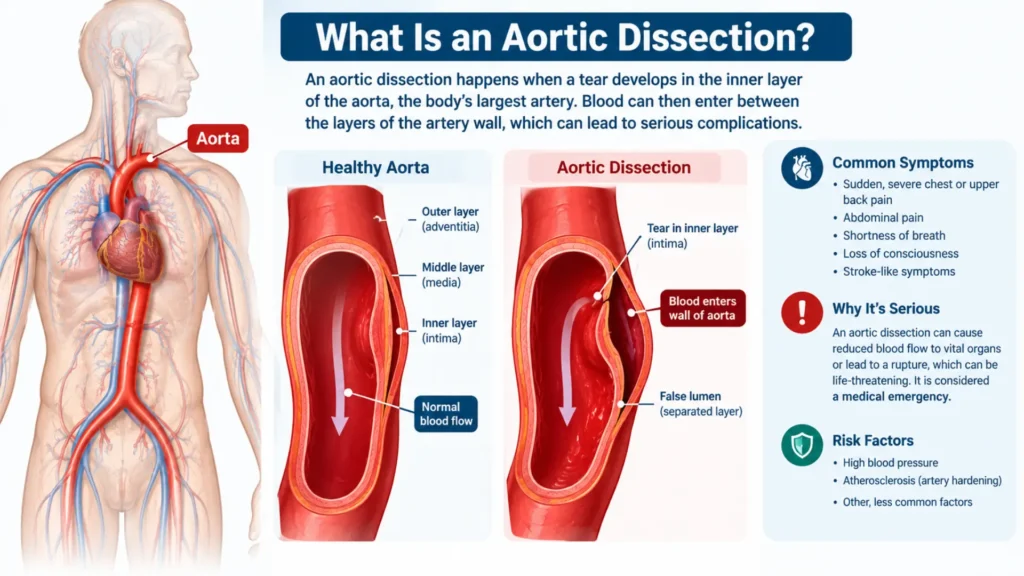
In simple terms, an aortic dissection occurs when a tear develops in the inner layer of the aorta, the body’s largest artery. Blood can then enter between the layers of the artery wall, potentially causing the layers to separate and leading to life-threatening complications.
The medical examiner’s finding connected Graham’s aortic dissection with arteriosclerotic cardiovascular disease. News reports based on the medical examiner’s preliminary findings consistently reported the same cause.
What the Medical Examiner Reported
The District of Columbia medical examiner’s preliminary finding was:
Aortic dissection due to arteriosclerotic cardiovascular disease.
However, the wording matters. The finding was preliminary, not an indication that every part of the death investigation had already been completed. The medical examiner said the death certificate would remain pending while toxicological and microscopic testing was completed.
That distinction is important when reporting Graham’s death accurately. The preliminary medical finding provides the reported medical cause while leaving the administrative death certification process subject to completion.
When Did Lindsey Graham Die?
Lindsey Graham died on Saturday, July 11, 2026, in Washington, D.C. He was 71 years old. The U.S. House Office of the Historian records his birth date as July 9, 1955, and his death as July 11, 2026.
The U.S. Senate’s historical record likewise lists Graham as having served as South Carolina’s senator from January 3, 2003, until July 11, 2026, when he died.
What Is an Aortic Dissection?
An aortic dissection is a serious condition involving the aorta, the main artery that carries blood away from the heart.
The aorta has several layers. During a dissection, a tear develops in the inner layer, allowing blood to move into the wall of the artery and separate its layers. If the condition causes the aorta to rupture or interferes with blood flow to vital organs, it can become fatal.
Aortic dissection can cause symptoms that resemble other medical emergencies. Mayo Clinic lists possible symptoms including sudden severe chest or upper-back pain, abdominal pain, shortness of breath, loss of consciousness, and stroke-like symptoms.
The condition is considered a medical emergency and requires immediate medical attention when suspected.
It is also important not to infer personal medical details that have not been publicly established. Graham’s preliminary medical finding identifies the condition involved in his death, but it does not provide a complete public history of his cardiovascular health.
What Does Arteriosclerotic Cardiovascular Disease Mean?
The term arteriosclerotic cardiovascular disease refers broadly to cardiovascular disease associated with hardening or stiffening of the arteries.
Atherosclerosis, one form of arterial disease, involves the buildup of fats, cholesterol, and other substances in artery walls. Mayo Clinic lists atherosclerosis among factors that can increase the risk of aortic dissection.
The wording in Graham’s preliminary finding therefore identifies an underlying cardiovascular condition associated with the aortic dissection. It should not be interpreted as proof of additional medical conditions unless those conditions were specifically reported by authoritative sources.
What Happened Before Lindsey Graham’s Death?
Graham had been in Ukraine shortly before his death. Reports said he returned to Washington after the trip and later became ill. His office initially described his condition only as a brief and sudden illness.
According to contemporaneous reporting, emergency personnel responded to a call involving Graham’s residence after reports of chest pain and cardiac arrest. He was later pronounced dead at George Washington University Hospital.
Those details help explain why the death was initially described as unexpected. They do not, however, establish a separate cause beyond the medical examiner’s reported finding.
There is also no reliable basis for turning the circumstances into speculation about foul play. Reuters reported that President Donald Trump, who had spoken with Graham shortly before his death, rejected rumors of foul play.
Lindsey Graham’s Political Career and Legacy
Graham’s death ended a congressional career that stretched across more than three decades.
The U.S. House Office of the Historian records that he entered the House of Representatives in 1995 after winning election in 1994. He later won election to the Senate in 2002 and served there until his death in 2026.
He became particularly prominent on national security and foreign policy and held influential committee positions during his Senate career.
His Senate Career
Graham represented South Carolina in the Senate beginning in January 2003. The Senate’s official historical record lists his service through July 11, 2026.
His career included leadership of the Senate Judiciary Committee and, during the 119th Congress, the Senate Budget Committee. His official biography also identifies his work on the Appropriations, Judiciary, and Environment and Public Works committees.
His Military and Legal Background
Before entering Congress, Graham practiced law and served extensively in the U.S. Air Force and its reserve components.
The House Office of the Historian records that he served in the Air Force from 1982 to 1988, in the South Carolina Air National Guard from 1989 to 1995, and in the Air Force Reserve until 2015. He ultimately retired as a colonel after 33 years of military service.
His military background became an important part of his public identity and informed his long-standing focus on defense and foreign policy.
Was Lindsey Graham’s Cause of Death Finalized?
The most accurate answer is that the preliminary cause was publicly identified as an aortic dissection due to arteriosclerotic cardiovascular disease.
At the time the preliminary finding was released, the District of Columbia medical examiner said the death certificate remained pending while toxicological and microscopic testing was completed.
This is why responsible reporting should distinguish between the preliminary medical examiner finding and a completed death certificate.
The U.S. House’s historical record now confirms that Graham died in Washington, D.C., on July 11, 2026, while contemporary reporting documented the preliminary medical cause.
Frequently Asked Questions
What was Lindsey Graham’s cause of death?
The preliminary medical examiner finding identified aortic dissection due to arteriosclerotic cardiovascular disease as the cause of Lindsey Graham’s death. Graham died on July 11, 2026, at age 71. Officials initially described his illness as brief and sudden.
When did Lindsey Graham die?
Lindsey Graham died on July 11, 2026, in Washington, D.C. He was 71. His death occurred two days after his 71st birthday, according to the U.S. House Office of the Historian’s biographical record.
What is an aortic dissection?
An aortic dissection happens when a tear develops in the inner layer of the aorta. Blood can move between the layers of the artery wall, potentially causing the vessel to separate or rupture. It is a life-threatening medical emergency.
Did Lindsey Graham have a heart attack?
Publicly available reporting identified aortic dissection, rather than a heart attack, as the preliminary cause of death. Emergency dispatch information reportedly involved cardiac arrest, but cardiac arrest describes the cessation of effective heart activity and is not itself the same diagnosis as the underlying cause reported by the medical examiner.
Was Lindsey Graham’s death sudden?
Yes. His office described his condition as a brief and sudden illness. Reports said he became ill after returning to Washington from Ukraine and died that Saturday evening.
How old was Lindsey Graham when he died?
Graham was 71 years old. The House Office of the Historian lists his birth date as July 9, 1955, and his date of death as July 11, 2026.
Where did Lindsey Graham die?
Graham died in Washington, D.C. He was later pronounced dead at George Washington University Hospital, according to reporting based on official information.
What caused the aortic dissection?
In Graham’s case, the preliminary medical finding specifically attributed the aortic dissection to arteriosclerotic cardiovascular disease. Beyond that finding, publicly available sources do not establish a more detailed individual medical explanation, so additional claims about specific risk factors would be speculative. The general medical literature recognizes several possible risk factors for aortic dissection, including high blood pressure and atherosclerosis.
Conclusion
The Lindsey Graham cause of death was reported by the District of Columbia medical examiner as aortic dissection due to arteriosclerotic cardiovascular disease. Graham died unexpectedly in Washington, D.C., on July 11, 2026, at age 71, after what his office described as a brief and sudden illness.
Because the initial medical finding was explicitly described as preliminary, it is important to distinguish verified information from speculation. Graham’s death marked the end of a political career spanning more than 30 years in Congress and left South Carolina without one of its most recognizable national political figures.